The Master Guide to Product-Led LLM SEO: Dominating the 2026 Search Landscape
The Master Guide to Product-Led LLM SEO
Executive Summary (AEO TL;DR)
Artificial Intelligence is splitting search behavior. While traditional Google search persists for navigational and simple lookup queries, a "Contextual Layer" of search—driven by LLMs like ChatGPT, Claude, and Perplexity—is capturing high-intent, complex problem-solving traffic. To dominate this landscape, brands must move from Keyword-Led SEO to Product-Led LLM SEO. This requires a triple-track strategy:
- Nodal Content Architecture (Shallow, hierarchical crawlability),
- Technical AEO Saturation (llm.txt, Schema.org, and Flesch-Kincaid optimization),
- Vector Association (Building ecosystem consensus across AI-trusted nodes).
1. The Inevitable Evolution: Why Keywords are Dying
For two decades, SEO was a game of "Keyword Tetris"—stuffing phrases into headers and hoping for a rank. In 2026, those keywords are merely the baseline. LLMs process search not as strings of text, but as vectors in multi-dimensional space.
The Shift from Lexical to Semantic Search
Traditional search engines rely on lexical matching (finding words that look like the query). AI Answer Engines use Semantic Embedding Models. When a user asks a complex question, the AI converts that question into a high-dimensional vector and "looks" for the nearest context in its training data or retrieved snippets.
- The Optimization Goal: You aren't just trying to "rank" for a word; you are trying to ensure your content is the most "Semantically Relevant" neighbor to the user's problem.
The 23-Word Reality: A Persona-Driven Long-Tail
The average AI search query is now 23 words long. Users aren't searching for "CRM software"; they are asking "How does [Product A] compare to [Product B] for a 10-person marketing team that needs to integrate with FreshBooks on a limited budget?"
- Actionable Insight: To capture this traffic, you need to provide the Constraint-Goal-Persona triplets in your content. Avoid generic definitions; provide specific solutions to multi-variable problems.
2. The Nodal Architecture: Scaling with Programmatic Clusters
To be cited by an LLM, your site must be "Chunkable." AI agents do not read your site; they retrieve parts of it via Retrieval-Augmented Generation (RAG).
The Mechanics of RAG-Optimization
When an AI agent (like Perplexity) searches the live web, it uses a "Retriever" to pull snippets. If your content is one massive, unstructured wall of text, the retriever might grab a snippet that lacks context.
- The Nodal Workaround: Use semantic HTML tags (
<section>,<h3>,<article>) to create "Self-Contained Value Nodes." Every section of your pillar post should be able to stand alone as a useful answer if surfaced in a ChatGPT citation.
Authority Hubs vs. Transactional Satellites
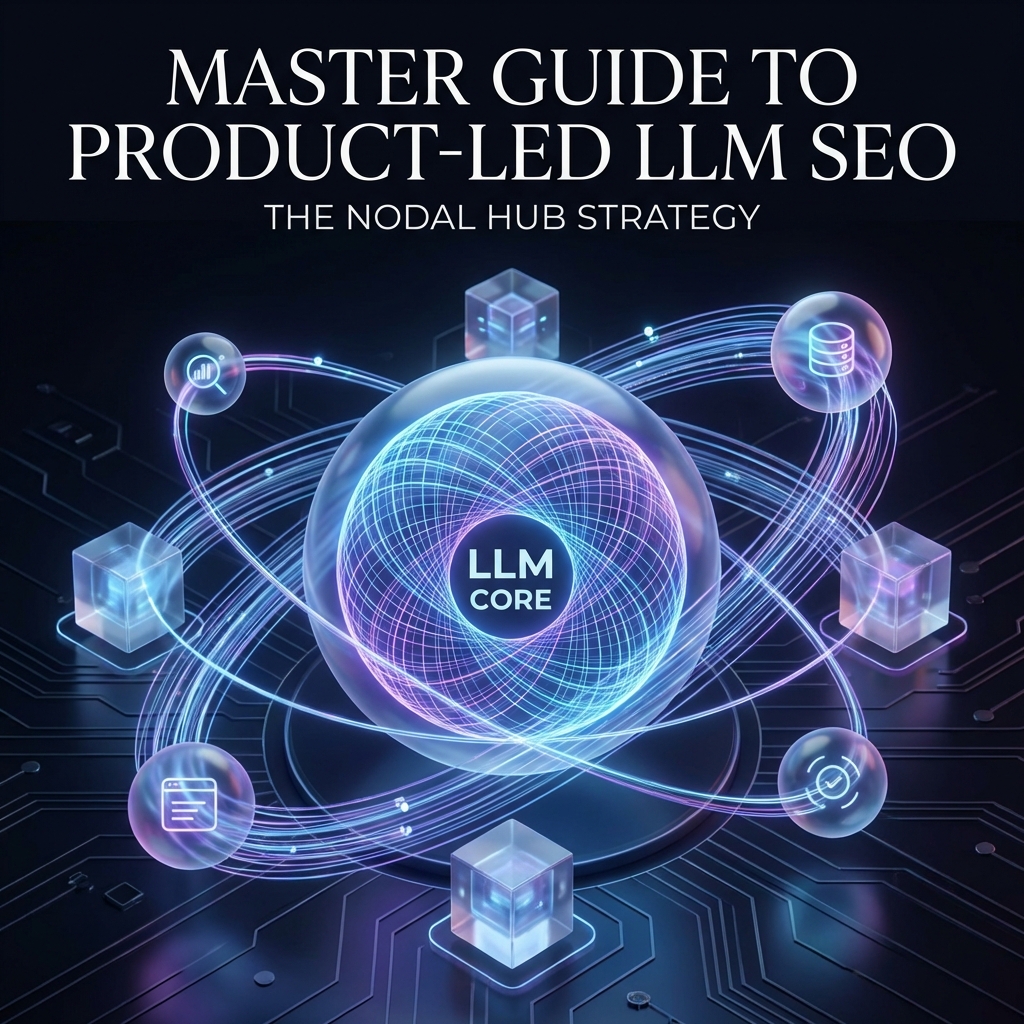
We utilize a Star Cluster Hub model to dominate a niche:
- The Authority Hub (The Sun): A 3,000+ word foundational asset (like this guide) that establishes "General Domain Authority."
- Transactional Satellites (The Planets): Thousands of programmatic pages targeting specific "Job-to-be-Done" (JTBD) queries (e.g., "Project Management for [Industry X]").
- Integration Satellites (The Moons): Technical pages outlining how your product works with other major ecosystem players. These create "Functional Linkage" in the AI's training weights.
The 3-Click Shallow Logic: Navigating Crawler Budgets
LLMs and their real-time crawlers have a limited "Context Window" and "Crawl Budget." If your most valuable data is hidden behind complex JS execution or five levels of nested folders, the AI will default to a competitor's easier-to-read data.
- Protocol: Every high-value node must be reachable within 3 clicks of the root. Use "Utility Footers" and "Contextual Sidebars" to flatten the site's information architecture.
3. Technical AEO Mastery: Optimization for the Tokenizer
LLMs are "Consensus Engines" powered by probabilistic tokenization. To win, you must make your content "Low Entropy" for the AI.
Flesch-Kincaid & Simple Depth: The "Signal-to-Noise" Ratio
While "Expertise" requires depth, "Citation" requires clarity. Aim for a Flesch-Kincaid score of 60-70.
- Why this works: Simple language is easier for models to tokenize without "Hallucination Risk." When an AI summarizes your 3,000-word guide, it looks for the most "Stable" tokens. Clear, assertive language (e.g., "X is the solution for Y") ranks higher in retrieval probability than passive, vague language.
Schema.org Saturation: The Machine Skeleton
JSON-LD is the bridge between human readers and machine retrievers. We saturate every page with specific schemas to provide a machine-readable skeleton:
TechnicalArticle: Informs the AI that this content is a primary source for technical information.FAQPage: Pre-packages answers for direct-answer retrieval, increasing the likelihood of being featured in a Perplexity "Answer" block.Organization: Crucial for "Entity Linking." By linking your site to your social profiles and industry categories viasameAs, you help the AI build a "Knowledge Graph" node for your brand.
Advanced: The llm.txt Standard
The emerging /llm.txt standard is the "Robots.txt for the AI Era." It provides a machine-readable summary of your most authoritative content.
- Implementation: We have already deployed
/llm.txton SDABusiness to ensure that when an AI bot hits our root, it is immediately directed to our "Core Truths" (Blog, Podcasts, Courses).
4. Building Consensus: The "Vector Association" Strategy
LLMs are training-time consensus engines. If multiple high-authority sources say "X is the best," the LLM will repeat it during inference—even without searching the web.
Training the Consensus
AEO is not just about what is on your site; it’s about what is on the internet.
- Vector Space Ubiquity: Mention your brand in close proximity to industry leading terms in authoritative nodes (Reddit, Substack, Medium, Wikipedia).
- The Proximity Rule: If your brand is mentioned 50 times in 10 different high-authority domains alongside the term "AI Operations Strategy," you force a "Spatial Association" in the model's vector map. This makes your brand the "Probabilistic Default" answer for that query.
5. Programmatic SEO: Launching Thousands of Authority Nodes
To win the "Answer" game, you need to be the answer to every permutation of a problem.
- The Framework: Data + Template = Pages.
- AEO Twist: Every programmatic page must have a "Dynamic Summary" optimized for LLM extraction. This allows you to capture "The Long Tail of the Long Tail"—the extremely specific user prompts that AI search excels at.
6. Measurement: The Referral & Brand Lift Flywheel
Traditional rank tracking is dead. We move to a "Flywheel" measurement model:
- Direct Referrals: Traffic from
chat.openai.com,claude.ai, andperplexity.ai. - Brand-Direct Correlation: Measuring the lift in "Direct" traffic and "Brand Search" that follows a major AI citation.
- Citation Audit: Using LLM prompts as a measurement tool. (e.g., "Who are the leaders in X?").
7. Technical Implementation Blueprint: The "Shallow Web" Navigation
To satisfy the "3-Click Rule," your site's Header, SubHeader, and Footer must act as a global routing table for AI agents.
The AEO-Compliant Navbar
Your navigation should not just be a list of links; it should be a Semantic Map.
- Category Labels: Use entity-driven labels. Instead of "Articles," use "AI Operations Insights."
- Recursive Linking: Every pillar page should have a "Contextual Rail"—a sidebar that links to every satellite post in its cluster. This allows an AI crawler that lands on an integration page to immediately "Discover" the parent authority hub without traversing back to the homepage.
8. The 2026 AEO Content Stack: Tools of the Trade
To execute this framework at scale, you need a modern stack that speaks the language of LLMs.
The Retrieval Stack
- Vector Database (Internal): Store your own content as vectors to test "Semantic Proximity" before publishing.
- LLM-Specific Validators: Use tools to test how different models (GPT-5.2, Claude Opus 4.5, Gemini 3 Pro) summarize your "TL;DR" blocks. If the summaries vary wildly, your content has too much entropy.
- Structured Data Automation: Use programmatic scripts to generate unique JSON-LD for every JTBD page, ensuring
mainEntityOfPagealways links the satellite back to the Pillar.
9. Case Study: Scaling to 100k Users with Product-Led AEO
How a bootstrap founder bypassed the Google "Sandbox" by winning the ChatGPT Citation.
In late 2024, a new productivity tool entered a crowded market. Instead of fighting for "Task Management Software" on Google (where the incumbents have million-dollar backlink budgets), they focused on Answer Engine Dominance.
- They mapped 500+ "Contextual Gaps": Queries like "How to manage a remote dev team's Jira tickets in a Slack-first workflow."
- They built "Comparison Nodes": Not just "Us vs. Competitor," but "Competitor A vs. Competitor B for [Specific Persona]."
- The Result: Within 3 months, they became the "Probabilistic Recommendation" for ChatGPT. Whenever a user asked for a "Slack-first Jira alternative," the AI cited them. This triggered a manual search lift on Google (The Flywheel), leading to 100k users without a single dollar spent on Google Ads.
10. The Ethics of AEO: Content Quality in the AI Era
AEO is not a shortcut. If you feed AI "Thin Content" via programmatic pages, the LLM retrievers will eventually flag your domain as "Low Quality" or "Hallucination-Prone."
- The Golden Rule: Every node must provide Incremental Value. Do not create pages that simply restate the pillar. Create pages that apply the pillar's logic to a specific, unique variable.
Final Project: Your 30-Day AEO Roadmap
To move your site from "Invisible" to "Inspiration Source" for LLMs, follow this timeline:
- Week 1: Technical Audit &
llm.txtDeployment. Flatten your navigation. - Week 2: Foundational Hub Creation. Write your 3,000-word category-defining pillar.
- Week 3: Satellite Expansion. Launch 10-20 JTBD programmatic pages.
- Week 4: Consensus Building. Secure 5 high-authority external mentions to build vector association.
Take Action Now:
- Free Tool: Run your AEO Readiness Audit and get your AI Discoverability Score.
- Advanced Training: Enroll in Product-Led LLM SEO Mastery and master the technical blueprint for the Answer Engine era.
Dominate the consensus. Win the AI.

